Lao-Tzu and Machiavelli
If you've ever seen the famous 1974 Christmas movie, "The Year Without a Santa Claus," you would understand what I mean when I say that the comparison of Lao-Tzu and Machiavelli is similar to that of Snow Miser and Heat Miser. They're polar opposites: literally.
Lao-Tzu, also known as Laozi, is best known for his contribution to the Tao Te Ching. This work discusses the way of the Tao (Dao) and how it is the key to a successful and peaceful life. Lao-Tzu's form of government is very calming. It is considered to be very smooth going and suggests that rulers or leaders should not force anything among their people. Any disruption of this peace would lead to a lack of harmony with the Tao. Lao-Tzu believed that losing this tranquility would result in war, heavy taxes, and cruel laws, all things in which he strongly disagreed with. In his work, known as the "Master," it defines the political principles of Lao-Tzu. While he made suggestions, none of his practice was forced. He simply believed that if one wanted to believe, then they could and if they did not, then it just wasn't their path.
Niccolo Machiavelli was an Italian Renissance philosopher who was best known for his publication, "Prince". In this writing, Machiavelli discussed how the role of a prince would be very difficult to obtain. He explained that in politics, the prince (meaning the ruler) should threaten his people and scare them to gain respect from them. Machiavelli goes into detail about the cruel punishments that should take place. He also believes that it is okay to lie as long as the aristocratic status stays in effect.
To compare the two works, of Machiavelli's, "Prince," and Lao-Tzu's,"Master," one could agree that they have no similarities at all, however, that is in fact, false. Although both philosophers have different mindsets on their ideal government, their main goal is to keep a more stable government and solve more problems before they arise. For example, Machiavelli, although harsh in his tactics, explains through his book, that whenever someone goes against him, they are to be punished. Machiavelli's approach is more physical and immediate, but Lao-Tzu's form of punishment is hesitant and karma-based . To disobey the Tao, it leads to a disruption of peace and balance in one's life, leading to punishment, not immediately, but eventually. Even though the two appear to be nothing alike, their philosophical goals are one in the same.
Lao-Tzu, also known as Laozi, is best known for his contribution to the Tao Te Ching. This work discusses the way of the Tao (Dao) and how it is the key to a successful and peaceful life. Lao-Tzu's form of government is very calming. It is considered to be very smooth going and suggests that rulers or leaders should not force anything among their people. Any disruption of this peace would lead to a lack of harmony with the Tao. Lao-Tzu believed that losing this tranquility would result in war, heavy taxes, and cruel laws, all things in which he strongly disagreed with. In his work, known as the "Master," it defines the political principles of Lao-Tzu. While he made suggestions, none of his practice was forced. He simply believed that if one wanted to believe, then they could and if they did not, then it just wasn't their path.
Like Snow Miser, Lao Tzu was considered to be very "CHILL"
when it came to his beliefs on how the government should be run.
|
Niccolo Machiavelli was an Italian Renissance philosopher who was best known for his publication, "Prince". In this writing, Machiavelli discussed how the role of a prince would be very difficult to obtain. He explained that in politics, the prince (meaning the ruler) should threaten his people and scare them to gain respect from them. Machiavelli goes into detail about the cruel punishments that should take place. He also believes that it is okay to lie as long as the aristocratic status stays in effect.
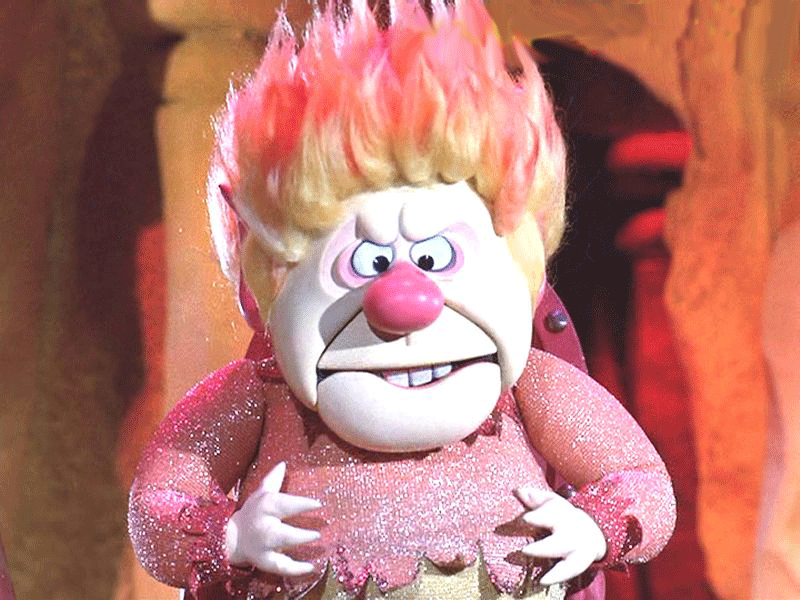 |
Machiavelli is very similar to Heat Miser when it comes to having a temper,
being dishonest, and abusing his power when it comes to authority.
|
To compare the two works, of Machiavelli's, "Prince," and Lao-Tzu's,"Master," one could agree that they have no similarities at all, however, that is in fact, false. Although both philosophers have different mindsets on their ideal government, their main goal is to keep a more stable government and solve more problems before they arise. For example, Machiavelli, although harsh in his tactics, explains through his book, that whenever someone goes against him, they are to be punished. Machiavelli's approach is more physical and immediate, but Lao-Tzu's form of punishment is hesitant and karma-based . To disobey the Tao, it leads to a disruption of peace and balance in one's life, leading to punishment, not immediately, but eventually. Even though the two appear to be nothing alike, their philosophical goals are one in the same.

No comments:
Post a Comment